
Intellectual Property (IP) is a crucial asset because it allows individuals and businesses to protect their creative works, inventions, and brand identities. To educate the public on this matter, two expert representatives from Biro Oktroi Roosseno were invited as guest speakers by SEA Today News, a prominent online news channel. The insightful interview featured Mr. Harry Wirawan (Litigation Head) and Mr. Taufik Andradi (Intellectual Property Consultant).
During the live studio session, the discussion thoroughly explored how crucial IP protection is for securing corporate investments and fostering market innovation.
According to the experts, intellectual property refers to the legal rights granted to individuals or organizations for their unique inventions, brands, and human creativity. These legal frameworks allow creators to control how their ideas are commercialized while preventing unauthorized exploitation.
Furthermore, Indonesia has established a solid track record in managing these rights through the Directorate General of Intellectual Property (DGIP) under the Ministry of Law.
“The process of creating something unique requires a significant investment of time, original ideas, and financial capital,” explained the team. “Consequently, securing official legal protection is non-negotiable for businesses to regain their investment and sustain competitiveness.”
Mr. Taufik Andradi detailed several essential categories of intellectual property rights that individuals and corporate entities must safeguard:
Patent Protection: Secures new technical inventions and technological advancements, ranging from mobile devices to everyday utility structures.
Trademark Registration Services: Protects distinctive signs, corporate names, and logos used in commerce to effectively differentiate products from competitors.
Copyright Protection Consultant: Safeguards original literary, musical, artistic works, and computer software.
In addition to defining the types of IP, the interview highlighted practical legal steps for businesses. One major challenge often faced by new enterprises is selecting an available brand name. To resolve this, a professional Intellectual Property Consultant Indonesia plays an optional yet highly vital role by conducting a comprehensive pre-filing search and providing structured legal opinions.
Indonesia strictly adheres to the first-to-file principle. Therefore, whoever registers the trademark first acquires the exclusive legal rights, effectively locking out late competitors.
[First-to-File Principle Flow]
Invention/Brand Idea ➔ Comprehensive IP Search ➔ Official DGIP Registration ➔ Exclusive Legal Ownership
For digital content creators, the experts delivered a reassuring legal fact regarding videos, photographs, and writings. Under Indonesian law, copyright protection is granted automatically upon publication. This means creators do not need to undergo mandatory formal registration with the DGIP to establish initial ownership. Nevertheless, respecting third-party creators by properly citing sources remains an essential practice in the digital ecosystem.
Enforcing your IP rights involves specific official government fees and professional legal fees if you choose to partner with an established indonesia intellectual property law firm. However, the long-term benefits far outweigh the initial costs.
As a premier IP Law Firm Southeast Asia, Biro Oktroi Roosseno has been helping clients navigate complex patent drafting, structured claim formulations, and trademark actions since 1951. Secure your corporate assets today by consulting with a trusted Kantor Konsultan HKI.
Source: https://www.youtube.com/watch?v=QI8vfd2zChc
The inspiring historical struggle of Rainha Boki Raja comes to life in a captivating new documentary film. Based on the lyrical prose by the late Prof. Dr. Toeti Heraty, this project highlights an extraordinary female leader. The film is led by Executive Producer Dr. Inda Citraninda Noerhadi and directed by Fendi Siregar.
Furthermore, this short documentary features a stellar creative team. Renowned screenwriter Linda Christanty wrote the script, while acclaimed maestro Ananda Sukarlan composed the music. With Gembong Hardian serving as Art Director and the legendary Christine Hakim as Narrator, this 29-minute HD film delivers a powerful cinematic experience equipped with English subtitles.
Rainha Boki Raja, also known as Boki Nukila, was the daughter of the Sultan of Tidore. Subsequently, she married the Sultan of Ternate, Bayanullah. Following her husband’s tragic passing, she bravely stepped forward to lead the state and government. This political move established her as the fierce Queen of 16th-century Ternate.
During her reign, she heroically waged war against the Portuguese Empire. At that time, the Portuguese represented the world’s first global imperialist force with territories spanning Asia, Africa, and the Americas.
Consequently, she pushed her political and strategic abilities to the absolute limit. She successfully navigated the complex turmoil between Ternate and Tidore during the height of Western colonialism. In addition, she successfully resisted the dominant patriarchal culture that governed the power structures and society of that era.
Ternate stands as one of the oldest and largest maritime kingdoms centered in North Maluku. The sultanate boasts a rich history spanning over 750 years. Therefore, preserving this legacy is of utmost historical importance. Since Indonesia’s independence, the Sultanate of Ternate has successfully transition into a revered cultural heritage institution.
This documentary film serves as an essential medium to broadcast her timeless legacy across various media platforms in Indonesia. In conclusion, the high quality of this production has earned official national recognition. The film has been proudly nominated for Best Short Documentary at the prestigious 2024 Indonesian Film Festival (FFI).
Director of Cooperation and Education of the Directorate General of Intellectual Property participated in discussing crucial issues in the field of Intellectual Property at the 20th Asia-Pacific Economic Cooperation – Intellectual Property Rights’ Experts Group (APEC-IPEG) meeting 58 in Lima, Peru from February 25 to March 1, 2024.
At the meeting, she conveyed the latest developments regarding the geographical indication (IG) protection policy in Indonesia, developments in the revision of the Industrial Design Law and Indonesia’s strategy to support small and medium businesses. On this occasion, it was also conveyed about the successful implementation of the DGIP flagship program in 2023 and introducing the DGIP flagship program in 2024.
She also explained the development of the Draft Industrial Design Law where it will increase the effectiveness of implementing the industrial design system, strengthen the Industrial Design Law, and align regulations with international developments in the field of industrial design.
“It is hoped that through the revision of this law a more conducive environment will be created for creation and innovation in the field of industrial design as part of the Intellectual Property system,” she explained.
During the meeting, participants of the APEC Economies conveyed the efforts that had been made to improve Intellectual Property services, as well as their contribution to the success of APEC’s priorities and work plans, such as the Aotearoa Plan of Action, implementing the Putrajaya Vision; the Bangkok Goals on Bio-Circular-Green (BCG) Economy; the La Serena Roadmap for Women and Inclusive Growth; and the San Francisco Principles on Integrating Inclusivity and Sustainability into Trade and Investment Policy.
On the sidelines of APEC-IPEC activities, bilateral meetings were also held with delegations from the United States, Canada and Korea regarding several follow-up activities or action plans. Apart from that, at the 58th APEC-IPEG meeting, Project Management Unit Training was also held which aims to guide the design and preparation of quality projects within the APEC framework.
(source: http://www.dgip.go.id)
The Indonesian delegation represented by the Director of Patents, Integrated Circuit Layout Design (DTLST), and Trade Secrets of DGIP attended the 17th Patent Cooperation Treaty (PCT) Meeting Working Group held at the World Intellectual Property Organization (WIPO) Headquarters, Geneva, Switzerland on Tuesday, February 20 2024.
“At this 17th meeting several agendas were discussed including Technical Assistance Under the PCT, PCT Online Services, Filing Medium of International Applications and Related Documents, Legal Measures to Support Electronic Processing, Personal Data Protection and the PCT, and several issues related to the implementation of the PCT,” he said.
He added that at this meeting a sharing session was also held by several PCT member countries regarding experiences in implementing the Patent Prosecution Highway (PPH). Then, on the sidelines of the series of meetings, a sharing session was also held related to the Relationship between Patent Cooperation Treaty and Patent Law Treaty (PLT).
He also said that through this meeting, Indonesia could find out about developments related to PCT. These developments can be administrative or substantive, including opportunities for Indonesia’s participation in PCT such as technical assistance or maximum capacity building.
“This forum is very important to follow carefully and continuously because it discusses issues related to the implementation and changes to the PCT system,” he explained
Indonesia has been a member of the PCT since 1997 based on Presidential Decree Number 16 of 1997 concerning Ratification of the PCT. In its implementation, to date 52% of the applications received by DGIP have been submitted through the PCT scheme.
(source: http://www.dgip.go.id)
Secretary of the Directorate General of Intellectual Property (DGIP) held a meeting with Deputy Director General for Regional and National Development Sectors of World Intellectual Property Organization (WIPO) to discuss the follow-up to the establishment of the Indonesia IP Academy in Geneva, Switzerland on Friday, February 2, 2024.
On this occasion, he conveyed the preparations that had been planned and implemented by DGIP regarding the establishment of the Indonesia IP Academy, especially regarding management support and infrastructure.
“We are currently preparing national regulations for the establishment of the Indonesia IP Academy. Apart from that, supporting infrastructure and facilities are also being prepared, one of which is a special library for Intellectual Property,” he explained.
Furthermore, he also conveyed several work plans for 2024 which had been prepared together at the WIPO office over the last five days, one of which was training activities delivered by the Indonesian Intellectual Property Training Institution (IPTI) with the WIPO Academy.
Deputy Director General for Regional and National Development Sectors of WIPO appreciated the efforts and welcomed the progress in the development of the establishment of the Indonesia IP Academy.
“This year WIPO has also prepared several programs, we hope to collaborate again with DGIP on several activities this year,” he concluded.
(source: http://www.dgip.go.id)
In a recent decision, the Intellectual Property Office of Singapore (IPOS) ruled in favour of Green Radar, an IT security firm, allowing them to register the trademark “grMail” (Trademark No. 40202109944T) for their services under class 42 and class 45. This comes after tech giant Google filed an opposition against the mark, citing potential confusion with their own established trademark “Gmail”. The case centered around whether “grMail” was confusingly similar to “Gmail” and could potentially dilute the distinctiveness of Google’s brand.
Google opposed the registration of “grMail” on the following grounds:
IPOS acknowledged a moderate degree of visual similarity between the two marks. However, they ultimately sided with Green Radar, finding the following:
This decision allows Green Radar to register the “grMail” trademark in Singapore for their IT security services and subsequently the mark has obtained registration in Singapore. Google was also ordered to pay Green Radar US$12,000.
This case highlights the importance of distinctiveness in trademark selection. While some similarity might exist, clear differentiating factors can be crucial in securing trademark registration.
(source: Biro Oktroi Roosseno Singapore)
The storage battery trademark dispute currently under trial at the Central Jakarta District Court involves a company from India that manufactures lead and electric storage batteries, which is the plaintiff, and a local businessman, who is the defendant.
The company, Exide Industries Limited, has ten international standard factories spread across five states in the country, out of which 8 factories are dedicated to lead-acid batteries and 2 factories manufacture Home UPS Systems. They also have manufacturing facilities in Sri Lanka, UK and Singapore and does business globally through its subsidiaries and international affiliates
They export its batteries to more than 60 countries across the globe. It has a strong 95,000+ distributor & dealer / sub-dealer network.
Pursuant to this matter, the Indian company filed a cancellation lawsuit against the said local businessman in the District Court of Central Jakarta under case number 117/Pdt.Sus-HKI/Merek/2023/PN Niaga Jkt.Pst.
The plaintiff is seeking to establish their ownership and first use of the SF SONIC trademark, as well as its recognition as a well-known trademark.
Both trademarks protected the type of goods in class 9, such as accumulator, car battery, accumulator, uninterruptible power supply device, battery and battery cell, lithium ion battery, dry battery, electric battery, lithium battery, storage battery, solar battery, battery for vehicle, battery for electric vehicle, battery for mobile phone, rechargeable battery, Inverter, power inverter, capacitor, battery box, charger for electric battery, electric power control equipment, electric cell and battery, solar cell, solar cell and power generation panel, Renewable battery system for providing backup power, Interruption-free power supply, etc.
They argue that the defendant’s registration of the mark was filed in bad faith and is substantially or entirely similar to the plaintiff’s mark, and they are seeking to have the registration declared null and void. Additionally, the plaintiff is seeking damages.
Currently, this case is still in the early stages of court hearings, and the court’s verdict still needs to be made.
(source: http://sipp.pn-jakartapusat.go.id;
https://www.exideindustries.com)
June 13, 2021 was our great sadness for the passing of Toeti Heraty N. Roosseno at the age of 87. She was the President Director of Biro Oktroi Rooosseno, who was also the first generation of Indonesian feminist thinkers, a great Indonesian poet and writer, philanthropist, philosopher, a humanist, a high integrity and dedicated professor and lecturer, an IP consultant, an excellent professional and a kind-hearted leader, which she consistently kept until her last moment.
Thus, to commemorate and celebrate her thoughts, Cemara 6 Galeri – Toeti Heraty Museum is organizing the archive exhibition “Aku dalam Budaya.”

Toeti Heraty made significant contributions to Indonesian thought and culture. One of her renowned and notable contributions is her dissertation, “Aku dalam Budaya,” a study of cultural philosophy theory and methodology. This dissertation earned her a Doctor of Philosophy degree from the Faculty of Literature at the University of Indonesia and also made her the first woman in Indonesia to attain a PhD in Philosophy.
This dissertation was first published by Pustaka Jaya in 1984 and reissued in 2013.
The exhibition gathered 250 cultural writings authored by Toeti Heraty from 1961 until her passing in 2021. It takes place at Cemara 6 Galeri – Toeti Heraty Museum, located at Jl. HOS Cokroaminoto No. 9-11, Menteng, Jakarta Pusat, from June 13 to July 13, 2024.
This archive exhibition was inaugurated by Hilmar Farid, the Director General of Culture at the Ministry of Education, Culture, Research, and Technology (Kemendikbud Ristek), who was also Toeti Heraty’s former student.
Curated by Dhianita Kusuma Pertiwi, this exhibition features various archives, such as photos, timelines, bibliographies, selected books, essays, documentary videos, and objects from Toeti Heraty’s residence. It also features expert speakers from various fields, reflecting Toeti Heraty’s contributions in education, arts, culture, philosophy, politics, and business. Discussions and book reviews arel also be held during the exhibition to enrich public knowledge about Toeti Heraty and her thoughts.
(source: Biro Oktroi Roosseno & many)
On June 4, 2024, AIPPI Indonesia Group held an international webinar entitled “Trademark Protection Procedures in Japan and Indonesia.” This prestigious virtual event attracted a highly diverse audience. The attendees included Intellectual Property Consultants, Law Firm Staff, Small and Medium Business entrepreneurs, and researchers from government or private institutions, alongside general public observers.
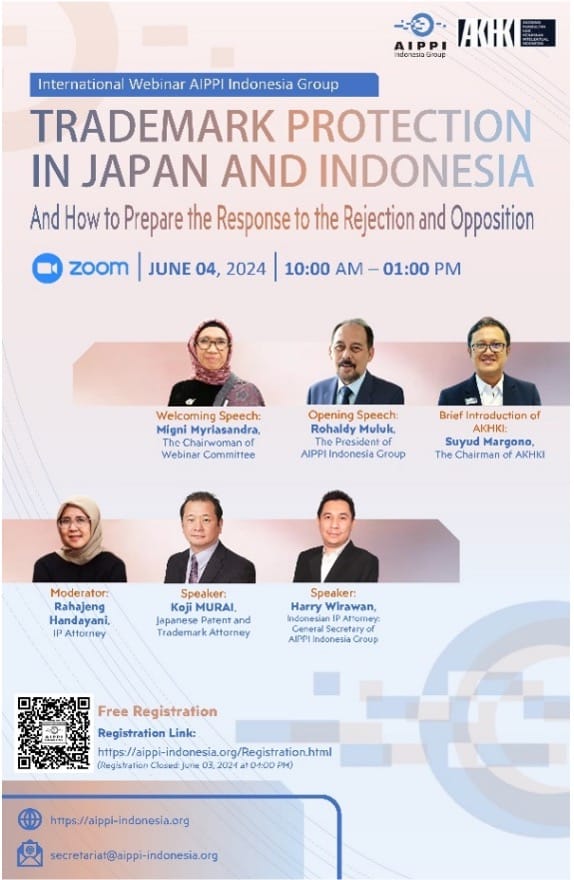
Mrs. Migni Myriasandra, Managing Director of Biro Oktroi Roosseno, served as the Chairwoman of the Webinar committee. In her opening speech, she stated, “This webinar aims to explain the important aspects of trademark registration and protection, particularly focusing on the procedures and challenges faced in both Japan and Indonesia.”
Mr. Harry Wirawan, an Indonesian Intellectual Property expert from Biro Oktroi Roosseno, was the first speaker in the webinar. Subsequently, the event moved into the second session. In this segment, Mr. Koji MURAI, a prominent Japanese Patent and Trademark Attorney, presented another interesting topic to the audience.
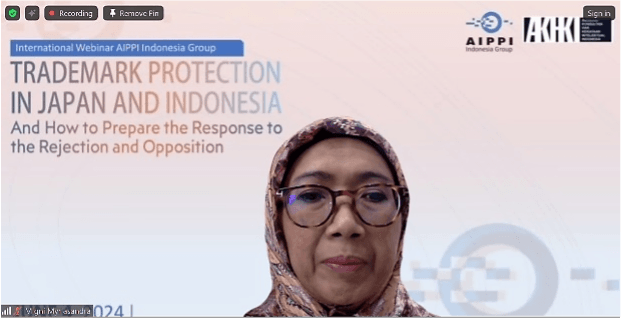
Furthermore, the discussions were closely centered around the critical trademark examination stage. The speakers specifically addressed scenarios where applications face refusal from the Directorate of Trademarks and Geographical Indications in Indonesia or the Japan Patent Office. Additionally, they provided practical insights on handling unexpected objections from third parties.
Mr. Wirawan elaborated on the official trademark registration procedures in Indonesia. He emphasized the distinct nuances of the process and related office actions. Moreover, he thoroughly explained the essential preparation and drafting process required for trademark responses or oppositions.
In the second session, the webinar explained the intricate details of the Japanese trademark system. Practical strategies for overcoming refusal grounds at the Japanese Patent Office were also highlighted. Consequently, these strategic insights provided attendees with highly valuable tips for their international applications.
Overall, this webinar serves as an essential platform for knowledge exchange and capacity building regarding trademark protection Indonesia Japan. The event successfully aims to empower SMEs and other attendees to navigate trademark challenges effectively. By doing so, it fosters a more robust IP ecosystem by equipping them with practical insights.
Therefore, this international webinar reinforces the critical importance of secure intellectual property rights. It is deeply concerned with boosting economic growth and encouraging continuous innovation in both countries.
In conclusion, having a registered trademark shields SMEs from infringement while significantly enhancing credibility and consumer trust. This legal protection is vital because it signifies the authenticity of their products. Moreover, trademark ownership facilitates seamless market expansion, boosts competitiveness, and ensures long-term legal safeguards under the law.
(source: Biro Oktroi Roosseno)
The Patent Appeal Commission, representing Indonesia’s Directorate General of Intellectual Property, conducted a virtual meeting with the European Patent Office (EPO) on Wednesday, June 26, 2024. This meeting marks an important step towards encouraging international collaboration and knowledge exchange in patent law and enforcement.
The primary objective of the meeting was to facilitate a comprehensive discussion on various aspects of patent protection systems. Key topics included examining the enforcement practices of patent laws in respective countries and exploring mutual learning and improvement.
The Public Policy Coordinator at the European Patent Office emphasized the importance of such engagements in strengthening global patent systems. He highlighted the value of sharing experiences and insights to collectively enhance the efficacy and fairness of patent protection worldwide.
During the meeting, the Deputy Chair of the Patent Appeals Commission presented an overview of Indonesia’s regulatory framework and operational practices.
“In resolving a patent case, the Patent Appeal Commission carries out three legal competencies, namely receiving, examining, and deciding,” the Deputy Chair stated. This structured approach ensures thorough examination and fair judgment in resolving patent disputes within Indonesian jurisdiction.
Furthermore, the Commission member elaborated on their procedural norms, highlighting the importance of summoning relevant parties for hearings to elucidate case details. In addition to stakeholder input, the Commission seeks opinions from expert witnesses, leveraging the expertise of patent specialists and examiners with scientific backgrounds.
“Apart from related parties, we also ask for opinions from witnesses and experts in their fields to get input. We added that we have patent experts and examiners with scientific backgrounds,” he added.
(source: http://www.dgip.go.id)